The flying billboards
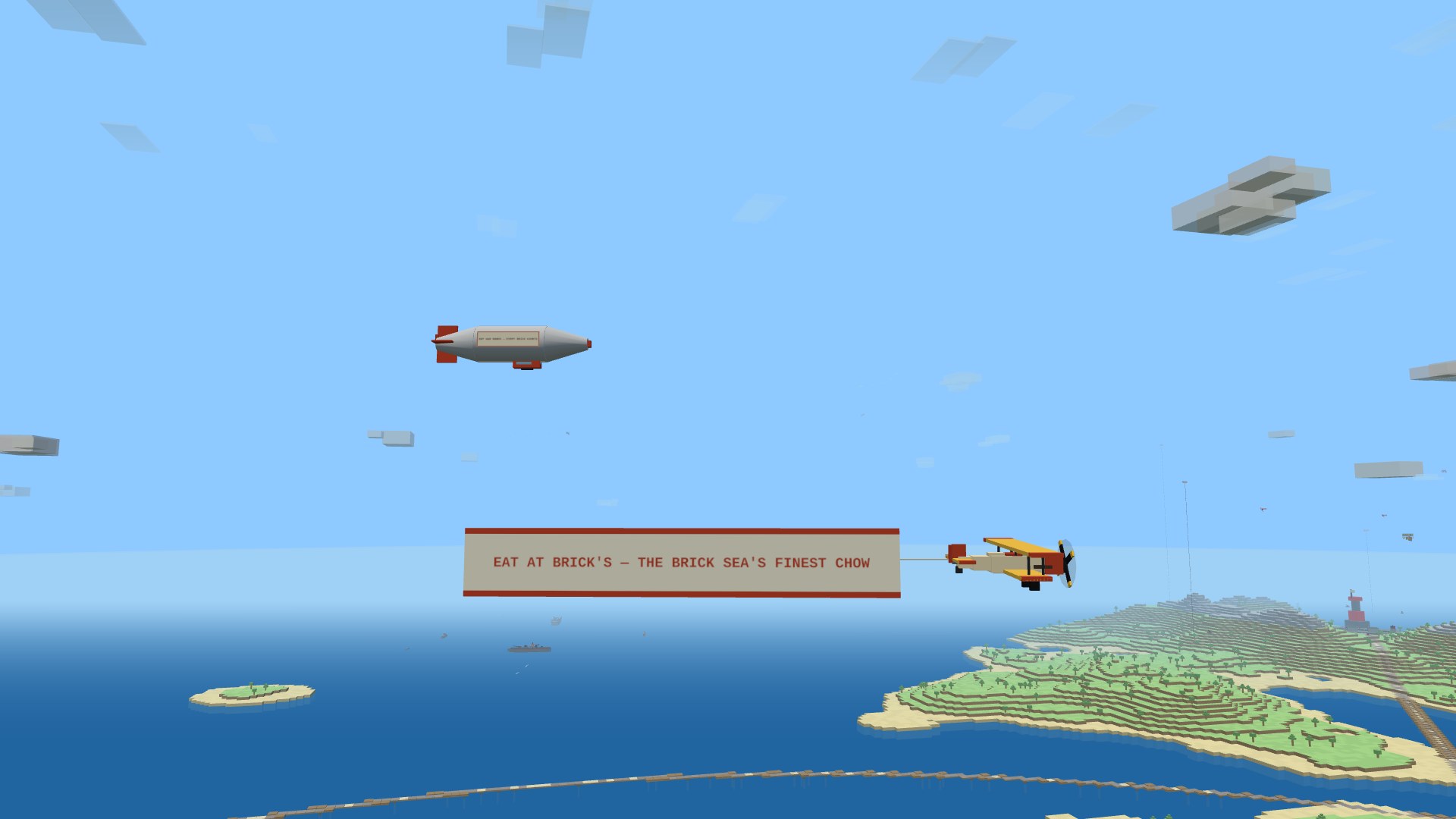
The Brick Sea got its first civilians who fly: Barnstormer Bess, a cream-and-gold biplane dragging the sponsor’s cloth, and Marquee Mo, an ad zeppelin with the message painted on both flanks. They tour the landmarks, sell things nobody in a warzone needs, and if you shoot one down — and you can — the sponsors just send another.
In the war but not of it
Bess and Mo aren’t on anyone’s side. They putter along their own sightseeing routes over the landmarks, oblivious to the dogfight raging around them — and the war is just as oblivious back. Bot pilots won’t chase them, flak batteries let them drone past, and the searchlights won’t waste a beam pinning a zeppelin that loiters over the ring all night. They don’t contest the Sky Ring, don’t clutter the scoreboard, and show up as a friendly little gold ring on your minimap rather than a bandit blip. Background charm, flying.
But you can shoot them, and it’s a guilty pleasure. Line one up and open fire — your rounds connect like they would on any plane. Popping one pays a token five points to your side and a cheeky line in the feed — never a real kill, a career stat, or a nemesis grudge. The wreck tumbles out of the sky (a falling zeppelin is worth the ammunition all on its own), and about thirty seconds later the sponsor simply sends a replacement droning in over the horizon. The show goes on; the message just moves to the next slogan.
Two very different flyers
They handle exactly like what they are. Marquee Mo is nine tonnes of gasbag: it lumbers along near walking pace, wallows into its turns like the building it is, and never met a hurry. Barnstormer Bess is the opposite — light, draggy, all lift, puttering happily along and near impossible to stall. Neither is going to trouble a fighter, which is the whole point. They’re there to be gawked at, waved at, and every so often ungraciously shot out of the sky.
Keep an eye out over the landmarks. Somewhere out past the furball, Bess is towing today’s slogan across the Brick Sea and Mo is doing slow laps of the Sky Ring — the war, correctly, does not care.